The 7-Line Landed Cost Formula: what an imported unit actually costs you
Seven lines that turn a supplier price into a true per-unit landed cost: goods, freight, insurance, duty, brokerage, inland, and late charges — divided by units received.
Short answer: The 7-Line Landed Cost Formula adds goods, freight, insurance, duty, brokerage, inland delivery, and late charges, then divides by the units actually received rather than the units ordered. The divisor is the line most importers get wrong.
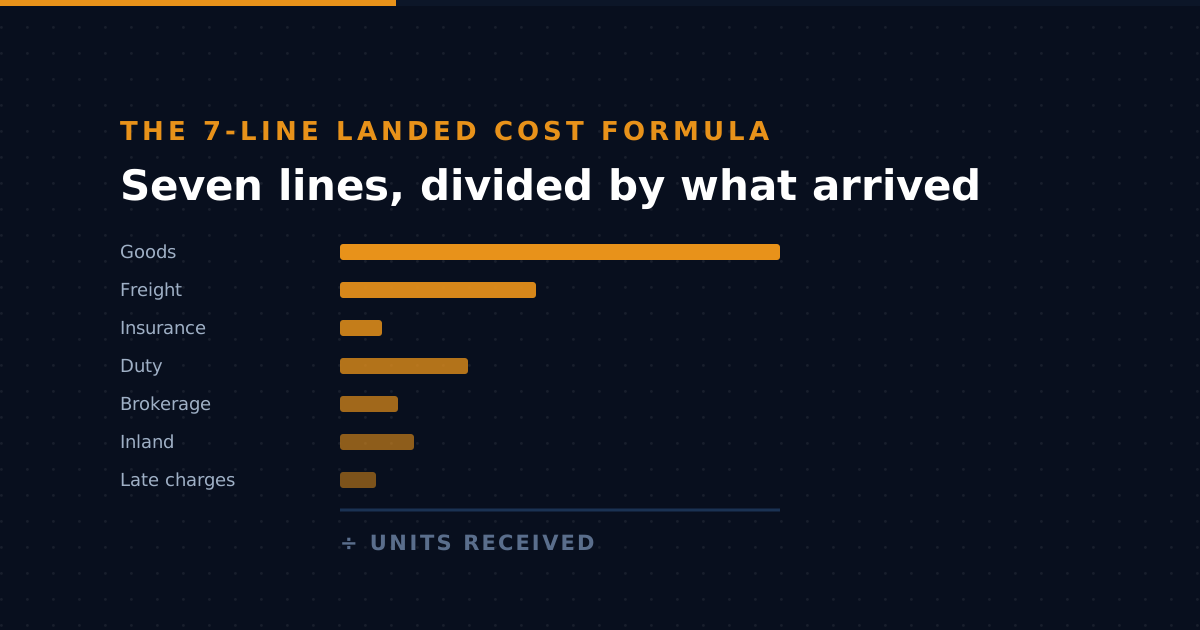
The 7-Line Landed Cost Formula turns a supplier price into what a unit actually costs you on your shelf. Add goods, ocean freight, insurance, duty, customs brokerage, inland delivery, and late charges — then divide by the units you actually received. The last instruction is the one most importers get wrong, and it is the one that decides whether your margin is real.
Why it matters: you price against per-unit cost. If that number is built from units ordered rather than units received, every short shipment quietly erodes a margin you believe you have.
The seven lines
- Goods — the confirmed proforma value, not the original quote.
- Ocean freight — if the Incoterm makes it yours.
- Insurance — same test as freight.
- Duty — customs value multiplied by your classification's rate.
- Customs brokerage — the broker's fee plus entry-related charges.
- Inland delivery — drayage, and unloading if billed separately.
- Late charges — demurrage, detention, storage, amendments.
Then: total ÷ units received.
| Line | Where the number comes from | Known at | Common error |
|---|---|---|---|
| Goods | Proforma invoice | Proforma | Using the original quote after the price changed |
| Freight | Carrier booking or supplier price | Shipped | Adding it under CIF, where it is already included |
| Insurance | Policy or supplier price | Shipped | Omitted entirely on small shipments |
| Duty | Entry summary | Arrived | Estimated at a guessed classification and never corrected |
| Brokerage | Broker invoice | Arrived | Treated as overhead rather than per-container cost |
| Inland | Drayage invoice | Received | Averaged across containers instead of assigned |
| Late charges | Terminal and carrier invoices | Weeks after Received | File closed before they arrive |
Why the Incoterm decides which lines you add
Lines 2 and 3 are conditional. Under FOB the supplier's price ends at the origin port, so ocean freight and insurance are yours to add. Under CIF both are already inside the price you were quoted, and adding them again inflates your cost and loses you business you should have won. The ICC Incoterms rules define exactly where cost and risk transfer.
Record the Incoterm next to the goods value. Without it, line 2 is a coin flip.
Why duty is the line you cannot estimate honestly
Duty is a percentage of customs value at the rate for your classification in the Harmonized Tariff Schedule. Two products that look identical on a shelf can carry materially different rates, and the difference falls straight to your margin. Before classification, any duty figure is a planning number.
If the rate materially affects your pricing, classify before you commit to the order rather than after the entry is filed.
What belongs in the formula and what does not
The formula covers costs that attach to a specific container. Costs that belong to the business as a whole do not go in, because spreading them across shipments makes every per-unit cost slightly wrong and none of them traceable.
Include — it landed on this container:
- Goods, freight, insurance, duty, brokerage, drayage, unloading.
- Demurrage, detention, storage, re-delivery, amended entry fees.
- Bank charges on the payment for these goods, if material.
- Inspection or lab testing required to release this shipment.
Exclude — it belongs to the period, not the box:
- Warehouse rent and salaries.
- Software, insurance on the business, professional fees.
- Marketing and selling costs.
- Financing costs not tied to this shipment.
The test is simple: if the container had never shipped, would this cost have disappeared? If yes, it is a landed cost. If it would have been incurred anyway, it is overhead.
Why the estimate and the actual should both be kept
Most importers calculate landed cost twice and keep only the second number. Keeping both is what turns the formula into a management tool rather than an accounting chore.
| Compare | What a persistent gap tells you |
|---|---|
| Estimated vs actual freight | Your forwarder's quotes are optimistic, or your lane has surcharges nobody mentioned |
| Estimated vs actual duty | Your classification assumption is wrong, and it is wrong on every shipment |
| Ordered vs received quantity | A supplier or a packing problem, visible only once you count |
| Estimate at Order vs final | Whether you can price a new product before the first container lands |
One container's gap is noise. The same gap across a year is a supplier conversation, a forwarder change, or a pricing correction — and none of those are available to you if the estimate was overwritten by the actual.
A worked example: reefer of produce, Santo Domingo to Miami
Illustrative figures. Ordered 2,000 cases; received 1,940 after rejection at inspection.
| Line | Amount |
|---|---|
| Goods, 2,000 cases at $11.40 | $22,800 |
| Ocean freight (FOB origin) | $3,900 |
| Insurance | $210 |
| Duty | $0 (duty-free classification) |
| Customs brokerage | $290 |
| Inland delivery | $540 |
| Late charges (2 days demurrage) | $300 |
| Total | $28,040 |
Divided by 2,000 ordered: $14.02. Divided by 1,940 received: $14.45. The gap is 43 cents a case — about three percent — and it is entirely invisible if the divisor is the purchase order.
On perishable goods the rejected portion is not recoverable volume, so pricing against $14.02 sells the shortfall at a loss on every case.
Where the formula meets the process
The seven lines arrive at different times, which is why landed cost is a process problem before it is an arithmetic problem. Lines 1 to 3 are known before the vessel sails. Lines 4 and 5 arrive at entry. Line 6 arrives on delivery. Line 7 can arrive six weeks later.
The Container Control Method exists to keep the file open until line 7 is settled: a container is not Reconciled until every cost that landed on it is attached to it. A landed cost calculated at Received is an estimate wearing the clothes of a final number.
In practice
Recalculate after late charges land, not before. A per-unit cost that was never revisited after a demurrage invoice is a number your sales team is quoting against in good faith and losing money on.
Count at receipt and use that count as the divisor. This is the single highest-leverage habit in the whole formula, and it costs one person twenty minutes at the dock.
Keep the estimate you made at Order next to the final figure. The gap between them, tracked over a year, tells you more about your freight forwarder and your suppliers than any single shipment can. Software that assigns costs per container can hold the file open and recalculate automatically, but a spreadsheet that is disciplined about the divisor will beat a system that is not.
Step by step
How to calculate landed cost on an import container
- Start from the goods value on the proforma. Use the confirmed proforma value, not the original quote, and note the Incoterm alongside it.
- Add freight and insurance only if the Incoterm makes them yours. Under FOB add both. Under CIF add neither — they are already inside the goods price.
- Calculate duty on customs value at your HTS rate. Apply the rate for your classification to the declared customs value, and treat any pre-classification figure as an estimate.
- Add brokerage and port charges. Include the customs broker's fee and any terminal or documentation charges billed on entry.
- Add inland delivery. Drayage from the port to your warehouse, plus unloading if it is billed separately.
- Hold the file open for late charges. Leave the container open until demurrage, detention, and storage invoices have either arrived or been ruled out.
- Divide by units actually received. Use the counted receipt quantity, not the ordered quantity. This is the line that changes the answer.
Frequently asked
What are the seven lines of the landed cost formula?
Goods, ocean freight, insurance, duty, customs brokerage, inland delivery, and late charges. The total is divided by the units actually received to give a per-unit landed cost.
Why divide by units received instead of units ordered?
Because you can only sell what arrived. Damage, shortage, and rejected goods reduce the divisor but not the cost, so dividing by units ordered understates your real per-unit cost every time a shipment is short.
Does the Incoterm change the formula?
It changes which lines you pay separately. Under FOB freight and insurance are yours to add. Under CIF they are already inside the supplier's price, and adding them again double-counts your cost.
How do I calculate duty before I know my classification?
You cannot, precisely. Duty is a percentage of customs value at the rate for your HTS classification, so an estimate before classification is a planning figure, not a cost. Classify early if the rate materially affects your price.
What counts as a late charge?
Any cost that arrives after the goods do — demurrage, detention, storage, re-delivery, amended entry fees, chargebacks. These are the lines most often missing from a spreadsheet because the file was closed before they arrived.