The Container Control Method: six stages that keep an import from drifting
A six-stage method for running an import container: Order, Proforma, Shipped, Arrived, Received, Reconciled — with the document and the number that prove each stage.
Short answer: The Container Control Method is a six-stage sequence for running an import — Order, Proforma, Shipped, Arrived, Received, Reconciled — where each stage has one document that proves it happened and one number that must match the stage before it.
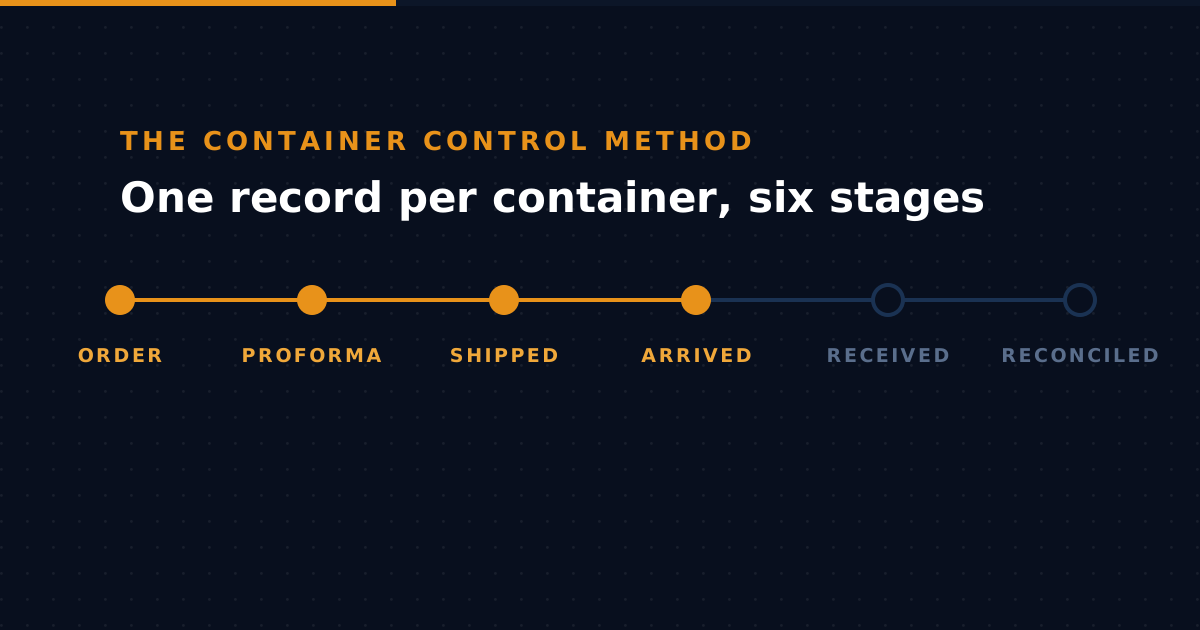
The Container Control Method is a six-stage sequence for running an import: Order, Proforma, Shipped, Arrived, Received, Reconciled. Each stage has exactly one document that proves it happened, and one number that must match the stage before it. A container is under control when every stage has both. Most import problems are a stage missing its proof.
Why it matters: the stages where importers lose money are not the dramatic ones. They are the quiet gaps — a proforma nobody compared to the purchase order, a received quantity nobody counted — and the cost surfaces weeks later, after the invoice is paid.
The six stages, and what proves each one
- Order — you commit to a quantity at a price under an Incoterm.
- Proforma — the supplier confirms that commitment in writing.
- Shipped — the goods are on the water and the carrier says so.
- Arrived — the container is discharged and cleared for entry.
- Received — you physically have the goods and have counted them.
- Reconciled — every cost is attached and the per-unit cost is known.
The method is a chain, not a checklist. Each stage carries a number forward, and the value of the method is that a mismatch is caught at the stage where it is still cheap to fix.
| Stage | What proves it | What money moves | What goes wrong |
|---|---|---|---|
| Order | Purchase order | Deposit, if terms require it | Incoterm left unstated, so nobody knows who pays freight |
| Proforma | Proforma invoice | Balance schedule agreed | Quantity or price differs from the PO and is paid anyway |
| Shipped | Bill of lading + packing list | Freight, if prepaid | Container number never recorded, so tracking is manual |
| Arrived | Customs entry summary | Duty, brokerage, port fees | Free time starts and nobody is counting |
| Received | Warehouse receipt | Drayage, unloading | Nothing is counted against the packing list |
| Reconciled | Cost summary per container | Final supplier balance | Late charges arrive after the file is closed |
Why the Incoterm decides half the stages
The Incoterm agreed at Order determines which costs appear later and who is responsible when they do. Under FOB the buyer's cost begins at the origin port, so ocean freight and insurance land on your side of the ledger. Under CIF both are already inside the supplier's price, and adding them again at Reconciled double-counts your cost. The ICC Incoterms rules define the transfer point precisely; they say nothing about when title passes or how you pay, which is a common and expensive confusion.
Record the Incoterm at Order, in the purchase order itself. Every downstream question about who pays for what is answered by that one field.
What each stage costs when it slips
Arrived is the stage with a running meter. Once a container is discharged, free time begins, and after it expires the terminal charges demurrage on the box sitting at the port. The Federal Maritime Commission's billing rule sets out what a demurrage or detention invoice must contain and who may be billed, which matters because a charge that omits required information can be disputed.
Received is the stage most often skipped. A short shipment found at Received is a credit note from the supplier. The same shortage found at Reconciled, after payment, is a negotiation.
What each stage should produce before it is allowed to close
A stage is done when it has produced its artefact, not when someone believes it happened. Treat these as exit conditions:
- Order closes when quantity, unit price, Incoterm, and ship window are all written down in one place.
- Proforma closes when the proforma has been compared line by line to the order and any difference is either resolved or explicitly accepted.
- Shipped closes when the container number, vessel, and sailing date are recorded, and the packed quantity matches the proforma.
- Arrived closes when entry is filed, the container is released, and the last free day is on the record.
- Received closes when a counted quantity exists — including a count of zero variance, which is still a count.
- Reconciled closes when no further invoice is expected and the per-unit cost has been compared to the estimate from Order.
The discipline is in refusing to close a stage early. A container marked Received because it arrived, rather than because someone counted it, has skipped the stage while appearing to have completed it — and that is worse than an obviously open file, because nobody goes looking.
Who owns each stage
The method fails quietly when every stage belongs to everyone. Assign each one to a person, even in a team of three:
| Stage | Usually owned by | The question they answer |
|---|---|---|
| Order | Purchasing | Did we agree the right quantity, price, and Incoterm? |
| Proforma | Purchasing | Does the supplier's confirmation match what we ordered? |
| Shipped | Logistics | Is it on the water, and do we have the documents? |
| Arrived | Logistics or broker | Is it cleared, and when does free time expire? |
| Received | Warehouse | What actually arrived, counted? |
| Reconciled | Finance | What did it really cost per unit? |
The handoffs are where information is lost, which is why the method insists each stage carries a number forward rather than a status. "Arrived" tells the next person nothing. "Arrived, 1,800 m² expected, last free day the 14th" tells them what to do.
A worked example: 40' HC of porcelain tile, Cartagena to Houston
Illustrative figures, not a quote — your duty rate depends on your classification under the Harmonized Tariff Schedule, and your freight depends on your contract.
| Line | Amount | Stage it is known |
|---|---|---|
| Goods, 1,800 m² at $9.20 | $16,560 | Order |
| Ocean freight, FOB Cartagena | $2,450 | Shipped |
| Insurance | $180 | Shipped |
| Duty at 8.5% of customs value | $1,408 | Arrived |
| Customs brokerage | $325 | Arrived |
| Drayage to warehouse | $640 | Received |
| Demurrage, 2 days past free time | $310 | Received |
| Total landed | $21,873 | Reconciled |
Received quantity was 1,782 m², not 1,800 — eighteen square metres broken in transit. Divide by what actually arrived and the per-unit cost is $12.27, not $12.15. The difference is small on one container and decisive across a year, and it is invisible unless Received records a count.
Where the method breaks in a spreadsheet
A spreadsheet can hold all six stages. What it cannot do is enforce that they stay attached to each other:
- The purchase order lives in one file, the proforma arrives as a PDF in email, and nobody compares them.
- The container number is typed twice, differently, so tracking and accounting refer to different boxes.
- Demurrage arrives six weeks after the container is closed, and the per-unit cost is never corrected.
- The person who knows where everything stands is the person who built the file.
In practice
Run the stages in order and refuse to skip Received. If you adopt one habit from this method, make it counting against the packing list before the container leaves your yard — it is the cheapest audit in the whole chain and the one most often skipped.
Keep the Incoterm, the container number, and the estimated landed cost on the same record from Order onward, so that Reconciled is a comparison rather than an investigation. Software that tracks costs per container can hold that chain together automatically, but the method matters more than the tool: a disciplined spreadsheet beats an undisciplined system.
Review your open containers once a week and ask a single question of each: which stage is it at, and does that stage have its document? A container that cannot answer is the one that will surprise you.
Step by step
How to run an import container through the Container Control Method
- Order. Issue a purchase order that states quantity, unit price, Incoterm, and expected ship window. This is the number every later stage is measured against.
- Proforma. Get the supplier's proforma invoice and check it line by line against the purchase order. Resolve any difference in quantity, price, or Incoterm before paying a deposit.
- Shipped. Collect the bill of lading and packing list. Confirm the container number, the sailing date, and that the packed quantity matches the proforma.
- Arrived. File customs entry against the commercial invoice and packing list, and track free time from the day the container is discharged.
- Received. Count what physically arrives against the packing list, and record the variance before the container leaves your yard.
- Reconciled. Attach every cost to the container, divide by units actually received, and compare the result to the landed cost you estimated at Order.
Frequently asked
What are the six stages of the Container Control Method?
Order, Proforma, Shipped, Arrived, Received, Reconciled. Each stage has one document that proves it happened and one number that carries forward to the next stage.
Do I need software to use the Container Control Method?
No. The method is a sequence, not a tool. It works on paper. What it needs is one record per container that everyone updates, rather than a document trail split across email, WhatsApp, and a spreadsheet.
Where do most importers lose control of a container?
Between Arrived and Received. The container clears customs and is delivered, but the received quantity is never checked against the packing list, so a short shipment is discovered weeks later when the supplier invoice is already paid.
What does 'Reconciled' actually mean?
Every cost that landed on the container — goods, freight, duty, brokerage, drayage, demurrage — is attached to it, and the total divided by the units received gives a per-unit cost you can price against.
Can a container be Reconciled if the supplier invoice is still unpaid?
No. Reconciled means the final numbers are known and matched. An unpaid invoice is fine; an unknown or disputed amount means the container is still at Received.